

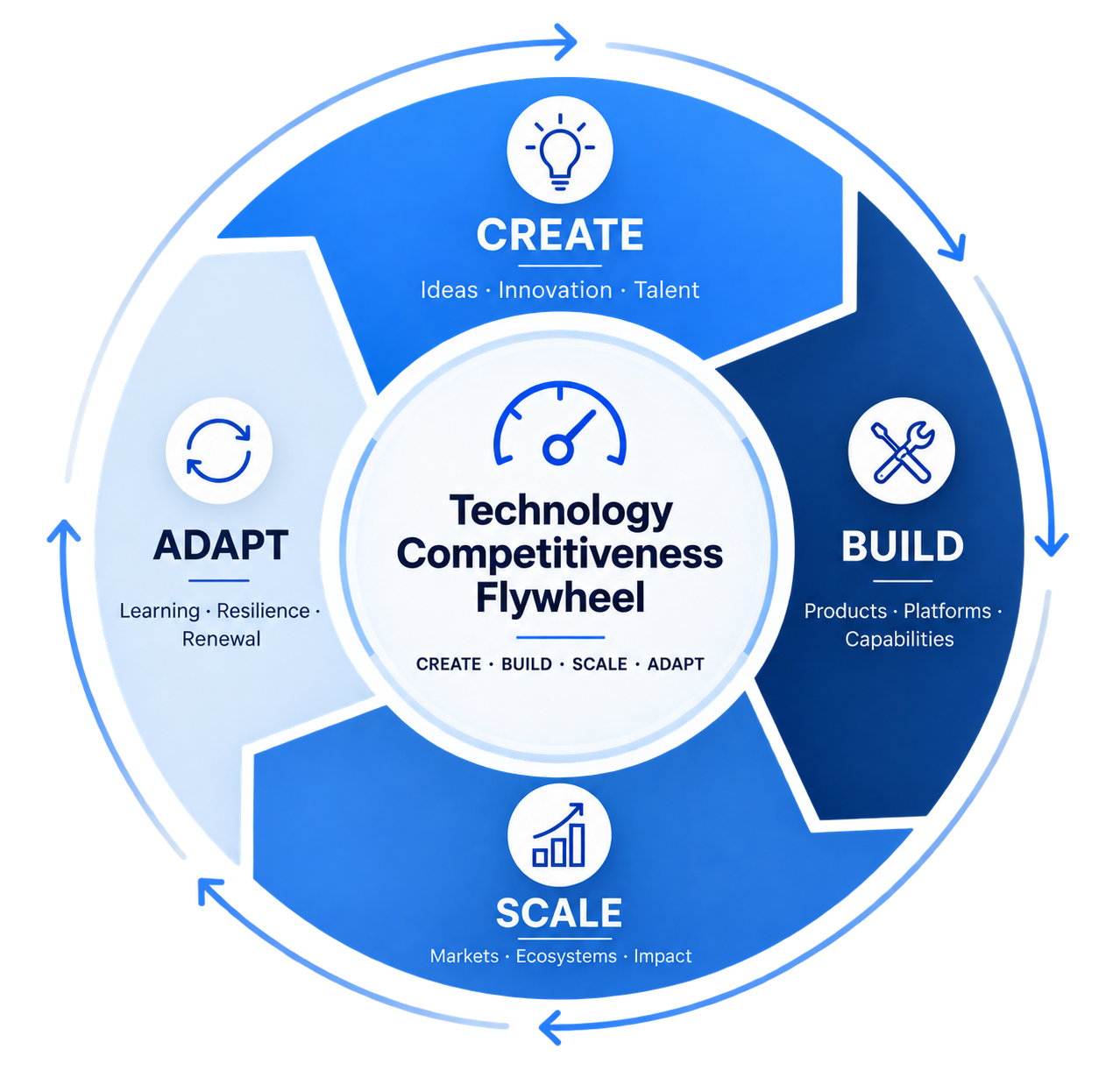
For decades, Europe has debated how it repeatedly “loses” new technology races.
Chips.
Internet platforms.
Cloud computing.
Artificial intelligence.
Robotics.
And now physical AI.
The explanations tend to be tired retreads:
More VC investment.
Less regulation.
Better universities.
Bigger domestic markets.
All of these have a part to play. But after almost three decades working across Silicon Valley, Europe, and China, I firmly believe that one competency underpins them all:
Speed
Not speed for speed’s sake.
Speed as a competitive advantage.
Technology markets reward learning.
Learning requires experimentation.
Experimentation requires speed.
The faster a company learns, the better it becomes.
The better a company becomes, the harder it is for others to catch up.
This is the defining characteristic of Silicon Valley.
And increasingly, of China’s tech economy.
Build Faster
The first manifestation is speed in building products.
One of the biggest shocks when I first moved to Silicon Valley was how quickly products were released to the market.
In Europe, products are almost always treated as incomplete until every possible specification has been laid out, discussed, vetted, and validated.
The goal is to build products perfectly from the start.
Silicon Valley operates in almost the complete opposite way—launch early, learn quickly, and iterate incessantly.
The customer is brought into the design and iteration process immediately.
Three concrete examples help illustrate this attitude toward products.
The product is launched early
A version of the product that offers one key piece of functionality is worth vastly more than a version two years down the road with every last bell and whistle.
Speed to market breeds learning.
Learning creates competitive advantage.
Customer feedback drives iteration
Real customers do things product managers never think of.
Instead of trying to anticipate everything in advance, companies observe customer behaviour and use it to decide what comes next.
Iterative design and improvement
Products constantly have bugs fixed, new ideas tested, features enhanced, and concepts refined.
Products are never “finished.”
Scale Faster
Second, speed influences how quickly successful products become global businesses.
Excellent technology development is only one piece of the pie; building a globally dominant company is another matter—and considerably harder.
It demands organizational speed beyond simply having access to capital.
Again, three distinct factors define Silicon Valley’s ability to scale rapidly.
Parallel experimentation
Companies rarely bet on one horse.
Instead, multiple teams iterate on different approaches simultaneously, and ultimately the market determines the winner.
Multiple innovation engines
Corporate R&D is only one source of innovation.
The most successful companies also invest heavily in startups, whether as partners or future acquisition targets.
In effect, they run dozens—sometimes hundreds—of experiments simultaneously.
Rapid resource allocation
Products that succeed quickly receive significantly more engineering, marketing, compute, and investment resources.
Adapt Faster
Perhaps the starkest contrast can be found in adaptation.
Leadership in technology is temporary.
Every technological revolution creates new winners.
Long-term competitiveness therefore depends not so much on today’s capabilities as on the speed of learning for tomorrow.
Organizations that consistently adapt successfully share three characteristics.
They are willing to cannibalize themselves
Waiting for competitors to force change is usually too late.
Successful companies challenge their own products before somebody else does.
They prepare systematically for the next technological shift
While one generation of products is being commercialized, another is already under development.
Often several competing approaches are pursued in parallel.
They embrace failure as part of learning
It is accepted that not every initiative will succeed.
Failure is treated as knowledge—not embarrassment.
Europe’s Different Path
Europe excels in many areas.
Engineering quality.
Reliability.
Precision.
Long-term thinking.
These strengths have produced world-class companies in manufacturing, automotive, industrial automation, pharmaceuticals, and precision engineering.
But software and AI operate under different rules.
Perfection before launch often leads to missed learning opportunities.
Consensus often slows decisive action.
Thorough planning often loses to rapid experimentation.
The objective is not to become careless.
The objective is to learn faster.
Searching for a European Way
Europe should not try to become Silicon Valley.
Nor should it attempt to copy China.
Their innovation ecosystems evolved under fundamentally different historical, cultural, and economic conditions.
Europe must, however, adopt many of the principles that have made these ecosystems successful.
Companies need to shorten decision-making cycles.
Governments must accelerate procurement and regulatory processes.
Universities need to celebrate entrepreneurship alongside scientific excellence.
Large corporations must complement internal R&D with strategic investments in startups and acquisitions.
But above all, Europe needs to embrace experimentation.
Speed does not diminish quality.
It shortens the distance between learning and action.
A Fourth Way?
The real opportunity for Europe is not imitation but synthesis.
Combine American entrepreneurship with Chinese execution and European engineering quality and reliability, while staying true to Europe’s own values.
Such a combination will not necessarily allow Europe to win every technology race.
But it could make Europe dramatically more competitive in the ones that matter most.
Conclusion
Technology leadership is determined less by who invents first and more by who learns, builds, scales, and adapts the fastest.
It is the companies—and ultimately the countries—that repeatedly build, scale, and adapt faster than everyone else that will shape the industries of the future.
The question for Europe is not whether it has the talent.
It clearly does.
The deeper question is whether it can develop the speed to transform those ideas into the kind of global impact achieved by the world’s leading technology ecosystems.