

The Global Technology Competitiveness Framework™
A Framework for Understanding Why Some Countries, Regions, Governments, Enterprises and Startups Repeatedly Win Technology Races
Introduction
Over the last four decades, technology has gone from one more sector of the economy to an increasingly core basis of national prosperity. The companies leading in semiconductor, software, digital platforms, cloud computing, AI and high tech manufacturing not only successfully innovate products, they absorb capital and talent, create well-paid jobs, sets standards, reinforce and expand networks of production and capture the wealth to provide for investment and public services. The accelerating cycles of technological development now require companies to not only have cutting edge research and an efficient R&D capability but to be able to spot future opportunities, to bring to bear the right investment and people quickly, to bring ideas to market rapidly, globalize, and be ready for the next waves.
There are few ecosystem that are really talented in doing this repeatedly; Silicon Valley has been behind three waves, China is already on multiple waves, while Europe continues to have an array of excellent companies, researchers and engineers but few global champions.
The story could not be more complex; there is not one cause. There is no problem of either talent,regulation or of public money in isolation to be so. However no country or ecosystem can achieve or maintain leadership on the backs of only one.
The true question is:
”what makes certain countries, regions and organizations so effective in managing, scaling and continuously adapting to the new wave of technology,while other fail, albeit possessing several of these capacities."
The Global Technology Competitiveness Framework™ was put in place to answer this query, by provide a methodological guide to the critical building blocs that will turn technological development into continued competitive advantage, prosperity and employment.
The Central Question
There has been no shortage of theories about why some nations have successfully capitalized on successive waves of technological change, only to have other countries fail. We have heard about capital; we have heard about education; we have heard about regulation, culture, industrial policy and demography. While each hypothesis can account for a portion of the phenomenon, none explains all of it.
After all, Silicon Valley, China, Switzerland, and Israel, the centers for current technology waves, vary significantly in terms of political systems, cultures and economic structures.
Nevertheless, each country has been able to repeatedly foster global technology champions. Likewise, a host of nations with high-quality education and research programs, first-rate universities, world-class engineers and robust industrial bases have proven unable to transform their basic capabilities into leading-edge innovations. Therefore, the question becomes less about whether capital, education, regulation, or culture should receive the focus—these factors obviously play crucial roles in driving the innovation landscape; rather, it becomes “How do the interconnected systems of these variables facilitate a country’s, a firm’s or even a small startup’s ability to establish, scale, adopt and adapt to the continually arising successive technological waves?” This paper contends that continuous technological competitiveness originates not in a discrete factor, but instead from the inter-relation of these key capabilities.
The Central Thesis
There is always someone who wins and someone who loses in a given technology revolution. However, usually, thewinner is not driven purely by technology per se; the historical pattern suggests that long-term technology leadership is not defined by an individual breakthrough, an organization, or an individual team of entrepreneurs. It’s an ecosystem’s success and persistence in adapting to technology disruption, and there are four fundamental capabilities that all the most competitive Countries/Regions/Governments/Enterprises/Start-ups possess:
They can:
Create new ideas, talent and opportunities.
Build technologies, products and companies.
Scale successful innovations into globally competitive ecosystems.
Adapt before the next technological wave makes today’s success obsolete.
These capabilities reinforce one another.
Weakness in any one of them eventually constrains the entire system.
This is the central idea behind the Global Technology Competitiveness Framework™.
Its purpose is to provide a practical framework for understanding, measuring and improving the ability of countries, regions, governments, enterprises and startups to repeatedly convert technological change into long-term competitiveness, prosperity and societal well-being.
The Framework
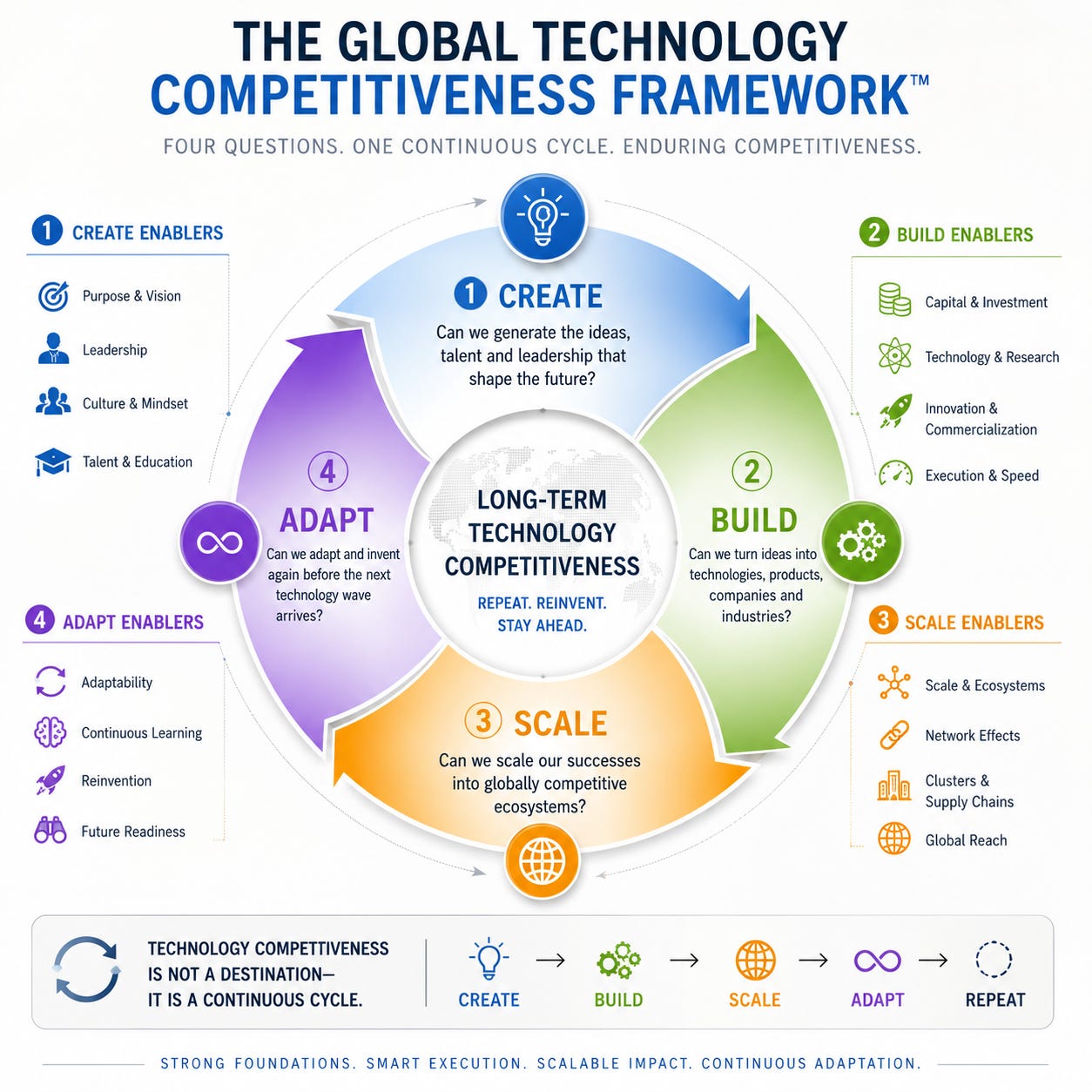
The Global Technology Competitiveness Framework™ is organized into three hierarchical levels.
At the highest level is the framework itself.
It provides a universal model for understanding and improving the long-term technology competitiveness of startups, enterprises, governments, regions and countries.
The framework is built around four fundamental capabilities.
Every startup, enterprise, government, region and country ultimately faces the same four questions.
Can We Create?
Can we generate the ideas, leadership, talent and ambition that make future innovation possible?
↓
Can We Build?
Can we transform ideas into technologies, products, companies and industries?
↓
Can We Scale?
Can successful innovations become globally competitive ecosystems?
↓
Can We Adapt?
Can we prepare for the future ahead of the expiration of advantages available to us today? We are able to do so only if we answer ‘yes’ to all these four questions. These capabilities are dependent on each other.
Companies that cannot create have no base on which to build.
Companies that cannot build are unable to scale. Companies that are unable to scale will be hard-pressed to produce the capital necessary for long-term innovative investment. Companies which fail to adjust ultimately stagnate because their existing strengths wear off. Hence, technology competitiveness is no resting place, but a dynamic, never-ending cycle; with each and every Technological Wave, it falls to organizations and communities alike to grapple with these 4 questions once more.
Each of the capability described requires a series of enablers underlying which comprise the ‘Enablers’.
Combined, the 4 Capabilities and 10 Enablers offer a powerful tool to assess and enhancing the organization. S, and the community’s technological competitive capabilities over the long haul.
The Four Capabilities
1. Can We Create?
Every innovation was conceived before the product was made.
Creating is finding compelling ideas, attracting great people and setting the conditions for innovative new ideas to come to pass. It is the means of addressing the following simple question.
Do we have the basis to be successful in the future?
There are four enablers to Creating.
Purpose & Vision
An ambition with longevity. A common vision. The commitment to pay today for becoming more competitive tomorrow.
Leadership
Having decisiveness skills. Bravery. Ownership.
Execution.
Ultimately, leadership determines whether transformation moves forward or stagnates.
Culture & Mindset
Mindset towardsentrepreneurship. Curiosity. Experimentation.
Learning from failures.
Continuous learning culture. Culture dictates how people & the company adapt to new circumstances or challenges.
Talent & Education
Engineers. Scientists. Business managers.
Educators.
Vocational workers. Immigrants. Competitiveness is a matter of people.
2. Can We Build?
An Idea by itself doesn’t result in prosperity. “Building is the act of converting ideas to products, technologies, businesses and even entire industries. “ It has to answer one question: Are we capable of repeatedly translating potential to reality? And there are 4 enablers for building:
Capital & Investment
Research funding.
Venture capital.
Corporate investment.
Private equity.
Public investment.
Capital fuels technological transformation. But capital alone is never sufficient.
Technology & Research
Scientific excellence.
Engineering capability.
Digital infrastructure.
Compute.
Patents.
Research institutions.
Technology provides the foundation upon which future industries are built.
Innovation & Commercialization
Turning research into products.
Products into companies.
Companies into industries.
Many societies excel at invention.
Far fewer excel at commercialization.
Execution & Speed
The ability to act.
To iterate.
To deploy.
To improve continuously.
Execution often matters more than invention.
3. Can We Scale?
Innovations deliver products. Scaling enables industries. Companies can achieve competitive advantage when successful innovations out grow them and flourish as globally competitive ecosystems.
Scaling is able to deliver the answer the age old question: Can success be sustainable?
There is only one enabler in scaling.
Scale & Ecosystems
Scaling successful ideas globally.
Building ecosystems rather than isolated companies.
Network effects.
Supply chains.
Clusters.
Global reach.
4. Can We Adapt?
Every competitive advantage fades. Because. Technologies change, markets shift, new entrants challenge incumbents.
Thus it’s not the one that has innovative ideas per se that is the real winner in the long term, it’s the winner that adapts – repeatedly.
Does that also mean: Can you predict the next technology paradigm early enough? Adaptation rests upon only ONE enabler.
Adaptability
An appetite to change and an ability to change. Rapid learning than competitors. Shift resources and capital.
Acquiring new competencies and new skills.
The formation of new industries. Preparation for the coming technological transformation in advance and constantly. Long-term competitiveness is based on the willingness and capacity to adapt.
The Framework at a Glance
Applying the Framework
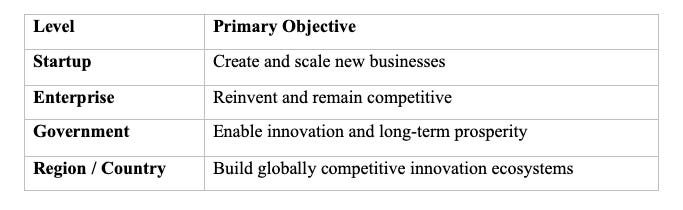
One of the defining characteristics of the Global Technology Competitiveness Framework™ is its universality.
The framework itself does not change.
Whether the subject is a startup, a multinational enterprise, a government or an entire country, the same four capabilities remain central:
Can we create?
Can we build?
Can we scale?
Can we adapt?
What changes is how these capabilities are interpreted and measured.
Each level requires different indicators, different priorities and different sources of competitive advantage.
Startup Competitiveness
Can this startup become globally competitive?
For startups, competitiveness is determined by the founder’s ability to repeatedly create, build, scale and adapt faster than larger competitors.
The framework evaluates questions such as:
Does the founding team possess a compelling vision?
Can the startup attract exceptional talent?
Can it secure sufficient capital?
Can it build products customers truly value?
Can it execute faster than competitors?
Can it scale internationally?
Can it continuously adapt as markets and technologies evolve?
The emphasis is on speed, experimentation and learning.
Enterprise Competitiveness
Can this company remain competitive in the next technology era?
For established enterprises, competitiveness is no longer defined solely by operational excellence.
It depends on whether the organization can repeatedly reinvent itself.
The framework evaluates:
Strategic leadership
Innovation capability
AI adoption
Organizational culture
Investment capacity
Execution speed
Commercialization capability
Ecosystem partnerships
Global scalability
Organizational adaptability
The emphasis is on continuous transformation rather than operational optimization.
Government Competitiveness
Is this government creating the conditions for long-term innovation and prosperity?
Governments rarely innovate directly.
Instead, they shape the environment in which innovation occurs.
The framework evaluates:
Education and talent development
Research and scientific excellence
Capital markets
Digital and physical infrastructure
Regulatory quality
Public procurement
Immigration and talent attraction
Entrepreneurial incentives
Technology adoption
National adaptability
The emphasis is on creating an environment in which innovation can flourish.
Regional & National Competitiveness
Can a region or country repeatedly compete in successive technological revolutions?
At the national level, competitiveness is determined by the strength of the entire innovation ecosystem.
The framework evaluates:
Leadership and long-term vision
Innovation ecosystems
Industrial strategy
Capital formation
Research capability
Technology adoption
Entrepreneurial culture
Global integration
Economic resilience
Long-term adaptability
The emphasis is not on winning a single technology race, but on building the capacity to repeatedly succeed across future technology waves.
A Universal Framework
Although the context changes, the underlying questions remain remarkably consistent.
Every startup, enterprise, government and country ultimately faces the same challenge:
Can we create?
Can we build?
Can we scale?
Can we adapt?
The answers determine their long-term technology competitiveness.
Measuring Technology Competitiveness
The Global Technology Competitiveness Framework™ is intended to be both conceptual and practical.
A framework only becomes valuable when it can be applied consistently, measured objectively and used to improve decision-making.
The next stage of this work is therefore the development of measurable indicators for each of the framework’s four capabilities and ten enablers.
These indicators will enable startups, enterprises, governments and countries to:
understand their current competitive position
benchmark themselves against peers
identify structural strengths and weaknesses
prioritize investment and reform
measure progress over time
The objective is not simply to produce another ranking.
It is to create a practical decision-making framework that helps leaders strengthen long-term technology competitiveness.
Over time, this work will evolve into assessment methodologies, maturity models, benchmarking tools and annual competitiveness reports.
Future Applications
The Global Technology Competitiveness Framework™ is designed as a universal framework.
Its principles remain constant.
Only the unit of analysis changes.
Potential applications include:
Startup Competitiveness
Enterprise Competitiveness
Government Competitiveness
Regional Competitiveness
National Competitiveness
University Competitiveness
Industry Competitiveness
Annual Global Technology Competitiveness Index
Each application uses the same four capabilities and ten enablers while adapting the assessment methodology to its specific context.
The First Application
The first major application of the Global Technology Competitiveness Framework™ will be presented in my forthcoming book:
The European Comeback
Why Europe Fell Behind—and How It Can Win the Next Technology Race
But rather than asking Why did Europe lose the technology race, the study used our analytical toolset to interrogate and question the nature of Europe’s technology system more generally.
By comparing Europe’s technology competitiveness with Silicon Valley and China, asking where its structural advantages and disadvantages are, and sketching out a coherent, actionable way to boost its overall technological competitiveness for the foreseeable future, the paper lays out the structure of the research described above.
Looking Ahead
The Global Technology Competitiveness Framework™ is intended as an evolving body of work.
It can remain relevant through research, data, executive education, advisory, writing, interviews, and implementation in startups, corporations, governments, and nations. It won’t aim merely to illustrate how innovation ecosystems grow or diminish.
It should arm leaders with a practical framework for the development, quantification, and enhancement of enduring technological competitiveness– for technological competitiveness is never static. Each successive technological era requires the ability to reinvent ourselves, to rebuild capabilities again and again to win.
Working Principle
Long-term prosperity belongs not to those who invent first, but to those who repeatedly create, build, scale and adapt better than everyone else.
Ralf Haller
Founder, Global Technology Competitiveness Framework™
Founding Paper – Version 1.0
July 2026
This is Version 1.0 of an evolving framework. I welcome comments, criticism and alternative viewpoints as the framework develops.
Every generation faces its own technology revolution.
Every generation must answer the same four questions.
Can we create?
Can we build?
Can we scale?
Can we adapt?
Full disclosure:
I wrote every idea in this essay myself. Because Substack is an overwhelmingly English-speaking community—and many readers understandably expect near-native English—I used an LLM purely as an editor to smooth the language. It didn't generate the arguments, the analysis, or the conclusions. Those are entirely mine.