Europe invented many of the technologies that underpin the modern world. Over the past forty years, however, it has frequently failed to develop many of the companies that rode these technologies to dominance.
Why?
This is a question I have spent a lot of time thinking about.
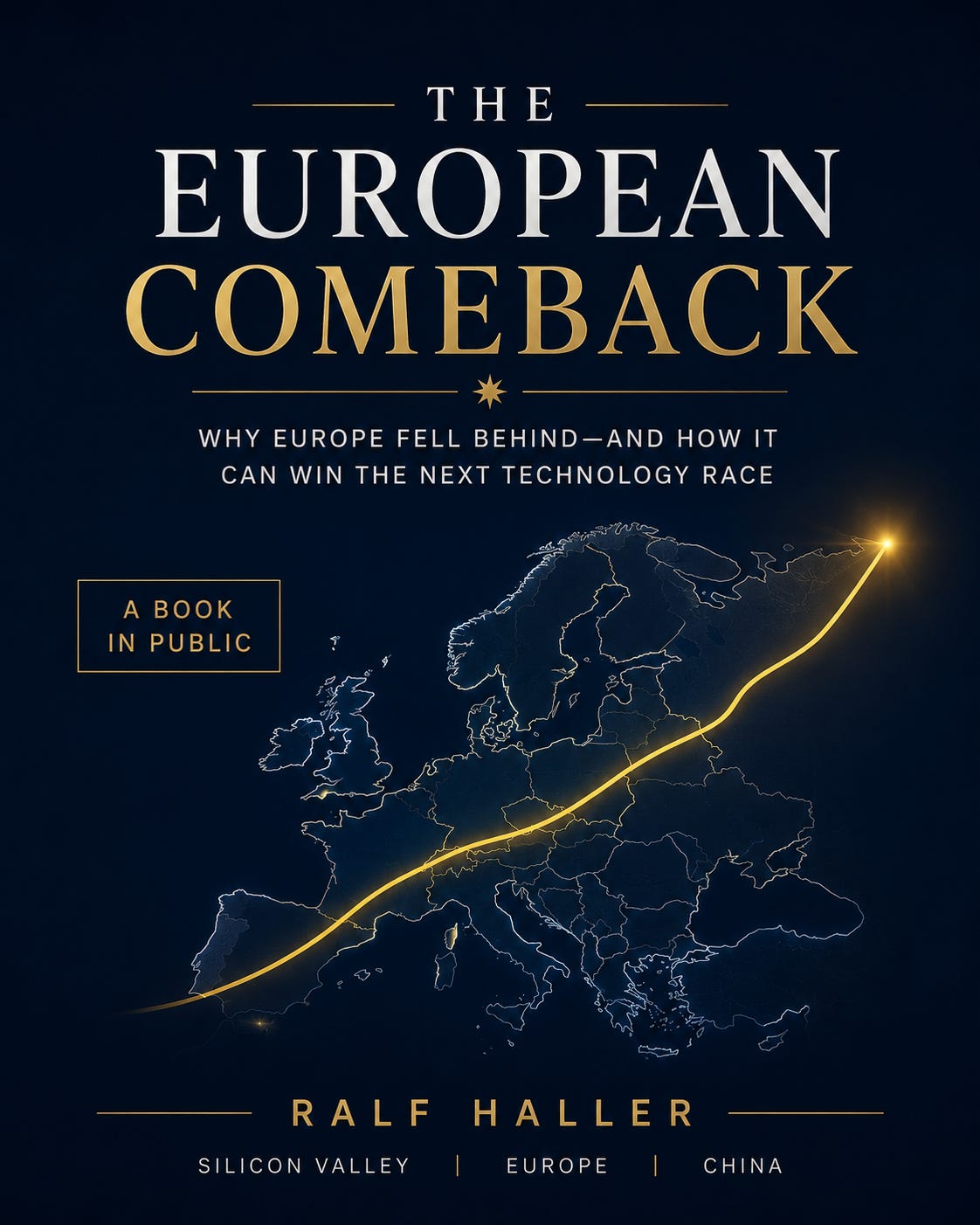
Over the next few months, I will develop the ideas for my next book in public. The working title is: The European Comeback Why Europe fell behind-and how it can win the next tech race. Rather than shutting myself away for a year to write a manuscript, I thought it might be more productive (and frankly, more fun) to share the process openly with you, through essays, interviews, discussions, data and research. My goal is to start a public conversation on how Europe can reclaim its technological leadership.
Consider this series an invitation to think together.
Many great reports and books have already described Europe’s many shortcomings in terms of competitiveness. Instead of rehashing the problem, I want to try and answer a broader question: When societies repeatedly capture industries of the future-how and why- and when do they miss them instead? Having worked for close to three decades, spanning Europe, Silicon Valley and China, I’ve had a rare advantage to see three radically different innovation ecosystems from the inside.
Each possesses different strengths and weaknesses; each develops unique methods of entrepreneurship, innovation, and technological change.I am not trying to persuade Europe to emulate Silicon Valley or China – nor should it. But I strongly believe that Europe needs to recover the capability to adapt and seize upcoming technology revolutions, all while preserving its own values and strengths. In the coming months, I will publish essays focusing on:· Four epochs that dramatically changed the global economy· The root causes of Europe’s lagging competitive position in technology· Insights fromSilicon ValleyandChina· the role of leadership, culture, and financing; and· a blueprint to restoreEurope’s competitivenessThe goal is to share the development of the book, not present a finalized masterpiece.
Some ideas will evolve; others may be proven incorrect along the way – that’s the nature of research.
I don’t claim to have all the answers; in fact, it’s the uncertainty that drives this endeavor, and that’s precisely why I’m publishing in public. I encourage you to engage in the discussion through your comments, criticisms, and alternative viewpoints. I look forward to your insights, as I’m sure many of you are entrepreneurs, engineers, investors, academics, or concerned citizens of Europe who have invaluable experience and perspectives to share. If this series leads you to refine some of your assumptions, challenge yourself or help to strengthen better ideas, it will be more useful as a collective work.
Welcome aboard!
— Ralf Haller