
Europe’s Competitiveness Problem Is Older Than Most People Think
A response to Jochen Sengpiehl’s excellent article “The China Shock. This Is Only the Beginning.”

Full disclosure: I wrote every idea in this essay myself. Because Substack is an overwhelmingly English-speaking community—and many readers understandably expect near-native English—I used an LLM purely as an editor to smooth the language. It didn't generate the arguments, the analysis, or the conclusions. Those are entirely mine.
There is little doubt that Europe is facing its biggest industrial challenge since the Second World War.
Jochen Sengpiehl recently argued that the “China shock” has only just begun. I agree with much of his analysis. China has built extraordinary capabilities in AI, robotics, batteries, manufacturing, supply chains and industrial scaling. Europe underestimated this transformation for far too long.
But I would argue that our problem is even deeper.
This is not a story of the last decade.
It is the result of two—perhaps even three—decades of slowly losing something that once made Western technology companies extraordinary.
The Real Gap Is Cultural
Whenever I speak with executives, one topic keeps coming up.
“Why are Silicon Valley companies so much faster?”
Having worked in Silicon Valley myself, I believe the answer is surprisingly simple.
Speed.
Not better engineers.
Not necessarily better ideas.
Simply speed.
Speed of decisions.
Speed of execution.
Speed of learning.
Speed of accepting failure.
European companies often mistake thoroughness for competitiveness.
Unfortunately, markets reward neither.
Markets reward whoever learns fastest.
Engineering Was Never Europe’s Problem
Germany still produces outstanding engineers.
Switzerland still produces world-class technology.
European universities continue to educate exceptional talent.
The problem is not capability.
The problem is what happens after the invention.
Too many decisions travel through committees.
Too many projects wait for consensus.
Too many companies optimise existing businesses instead of creating new ones.
Meanwhile, competitors iterate every week.
China Did Not Win Because It Was Cheap
Many Europeans still explain China’s success through low labour costs.
That explanation is now obsolete.
China’s competitive advantage today is scale, execution speed and industrial integration.
Companies don’t merely build products.
They build complete ecosystems.
Hardware.
Software.
Manufacturing.
Supply chains.
Data.
AI.
Customer platforms.
Everything moves together.
That is incredibly difficult to compete against when your own organisation is divided into functional silos.
Europe Cannot Do This Alone
One conclusion is becoming increasingly obvious.
Europe should stop thinking in geopolitical binaries.
It is not “America or China.”
Nor should technological sovereignty mean reinventing everything ourselves.
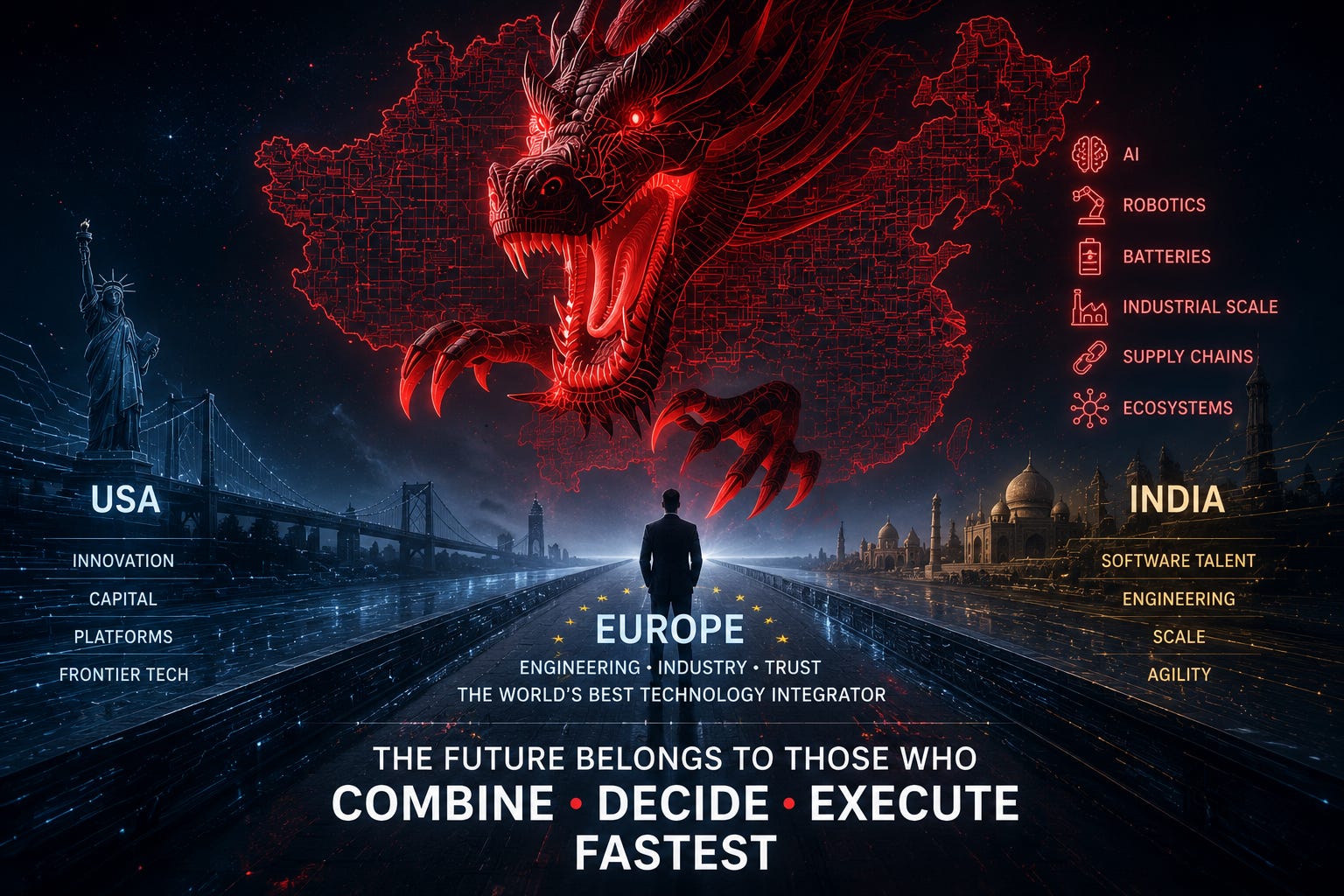
Instead, Europe should become the world’s best technology integrator.
Work with the United States where American companies lead.
Collaborate with India, arguably the world’s greatest software engineering powerhouse.
Engage with China where cooperation creates mutual value, while carefully protecting critical technologies and intellectual property.
The future belongs to those who know how to combine the best technologies globally—not to those who insist on inventing every component themselves.
First, Europe Must Restore Its Ability to Compete
The future technologies Jochen Sengpiehl mentions are important. But before Europe can lead in AI, robotics, batteries or quantum computing, it must restore the basic conditions required to compete at all.
Europe no longer has the same financial firepower as the United States or China. Capital is more limited, markets are more fragmented, energy is more expensive, and scaling is slower. Simply announcing another technology programme will not solve this.
Europe therefore needs smarter strategies: focus on selected areas where it has real strengths, use open-source technologies, combine capabilities across borders and build serious alliances with the United States, India and, where interests align, China.
Otherwise, Europe will enter this competition with what we say in Switzerland are “unequal-length spears”—fighting the same battle, but with fundamentally weaker means.
Stop Building Everything Yourself
This is where I believe Europe still misunderstands open source.
When outstanding open-source AI models already exist, why spend billions trying to reproduce what others have already built?
Instead, Europe should invest where it has genuine competitive advantages:
Industrial AI
Robotics
Engineering software
Manufacturing
Healthcare
Precision industries
Energy systems
Domain-specific AI
Winning rarely means building the largest foundation model.
Winning means creating the best products.
The Leadership Gap
Perhaps the biggest challenge is leadership.
Many strategic technology decisions are still made by people who have never built technology businesses themselves.
Reading reports is not the same as shipping products.
Attending conferences is not the same as competing globally.
Talking about AI is not the same as creating AI companies.
Europe needs more leaders who have experienced technology competition first-hand.
People who have failed.
People who have built products.
People who understand how quickly competitive advantages disappear.
The Race Is No Longer Between Countries
The race is no longer Europe versus China.
Or Europe versus America.
It is between organisations that learn quickly and organisations that don’t.
Between companies that execute and companies that analyse.
Between ecosystems and silos.
Europe still possesses enormous strengths.
Outstanding engineers.
Leading industrial companies.
Research institutions.
Global brands.
What it lacks is not intelligence.
It lacks urgency.
And urgency is one of the few competitive advantages that can still be created—if we choose to.
Because the next decade will not belong to those with the best plans.
It will belong to those who make decisions fastest, learn fastest and build fastest.